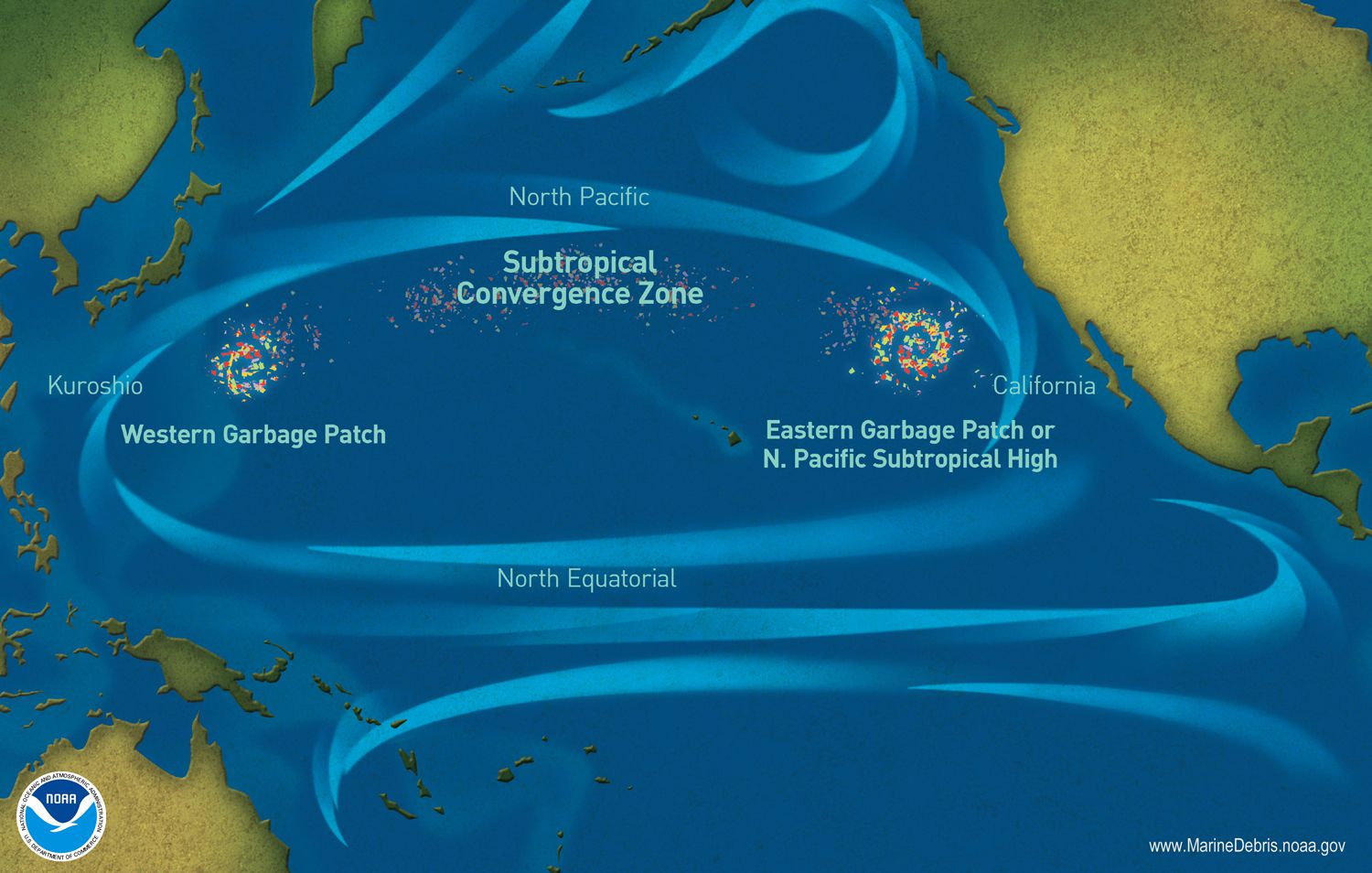
Just a couple weeks ago our class discussed the inevitable flooding of the nation of Kiribati, an island archipelago in the middle of the Pacific Ocean that is slowly being swallowed up by the rising waters. Likewise, we are starting to experience more hurricanes and other forms of natural disasters than ever before. Illegal dumping in the oceans has also caused a marked decrease in marine life, as many of the ocean's animals struggle to hunt for prey in an increasingly polluted natural habitat. In the Pacific Ocean there also exists two massive garbage clumps, a result of America and Asia's pollution converging in the ocean. They are each roughly the size of the State of Texas and early impossible to clean up. Obviously, it is difficult to regulate this on a local scale, so it is impossible to heal the planet on a global scale. Despite guidelines and regulations from the United Nations, the countries that do the most polluting in the world have zero obligation to follow them. There are no consequences for disobeying pollution regulations and even if there were, for example, financial punitive measures such as embargoes or fines, the companies and countries that are committing the pollution would almost certainly rather just accept their punishment and continue dumping. China, for example, is the world's largest polluter. They produce pretty much everything in the world, so it is no surprise that they also produce the most material waste. Their factories also produce an enormous amount of smog. In fact, more than 50% of the air pollution, or smog in the San Francisco Bay Area is actually air pollution that comes directly from Chinese factories.
In America, the federal government is essentially just turning a blind eye towards pollution. Upon taking office in 2017, President Donald Trump chose a cabinet comprised of climate change deniers. Trump, along with many other top Republican officials around the country insist that the idea of climate change is a hoax created by the Democratic Party to hurt American businesses. He selected Scott Pruitt as head of the Environmental Protection Agency. Pruitt himself claims that climate change is a hoax and has actually sued the EPA over a dozen times as a lobbyist for the fossil fuel industry.
In order for the world to actually come together to defeat climate change, there has to actually be serious consequence for companies and countries who continue to ravage the planet instead of simple slaps on the wrist. Likewise, there ought to be financial incentives for countries to want to be more green.
In Panama, the issue with pollution is very serious as a country that relies heavily upon the sea for nearly all of its industry. The only real business enterprises outside of the oceans are the fact that the nation is a tax haven. A few years ago, Greenpeace launched a campaign to help save the whales in Panama. On nearly every block of Panama city in 2014, there were murals, billboards, and street art celebrating whales and raising awareness of ocean pollution, something the Panamanian government has been guilty of in the past.
BLOG Post #4 due Sunday, 3/1
Read on Canvas-On Sustainability-Moral Ground-Watt-Cloutier (pp. 25-29).
- Assuming we all agree that we have a moral obligation to take action to protect the future of a planet in peril, what should these actions look like? What is being done by world leaders? Is there consensus?
- Are any other environmental groups working in your region? What is Greenpeace doing in your region?
- Larsen talk:
For many Indigenous societies, places have “agency.” (The etymology of the word “Indigenous” means “to be of a place.”) Places have power and personality. They can speak, create, and teach. Places are sometimes seen as Elders from deep in totemic genealogies through which humans and nonhumans are related.
How would Larsen respond to the claim that a place has agency? Why?
How do you understand that concept?

No comments:
Post a Comment